
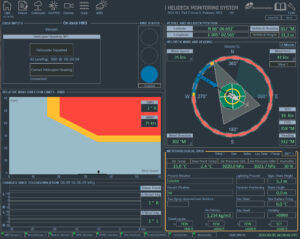
Key Functions
- Motion Monitoring: Tracks roll, pitch, heave, inclination, and accelerations to calculate the Motion Severity Index (MSI), preventing helicopter sliding or tipping.
- Meteorological Data: Measures wind speed, wind direction, barometric pressure, temperature, humidity, and visibility to compute the Wind Severity Index (WSI).
- Relative Wind Monitoring: Detects unsafe post-landing wind conditions or sudden squalls.
- Repeater Lights: Utilizes corner-mounted visual status lights (such as L430 HMS Repeater Lights etc.) to give pilots immediate visual feedback on deck motion limits.
For more info, UK Civil Aviation Authority Standards for offshore helicopter landing areas 2026 CAP-437-standards-for-offshore-helicopter-landing-areas-edition-9-amendm-1 page 48
Core Components Verified During a CAP 437 Light Test
A standard helideck lighting inspection validates several critical systems:
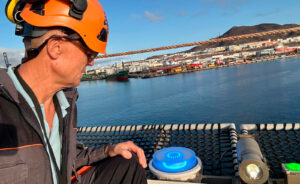
- Circle & H Lighting (TD/PM Circle-H): This is the core requirement mandated by CAP 437 to eliminate the dangerous "black-hole effect" during night approaches. The text/lines of the Touchdown/Positioning Marking (TD/PM) circle and the "H" must be structurally overlayed with integrated light fixtures that do not exceed 25mm in height.
- Perimeter Lights: Green omnidirectional lights that mark the boundaries of the Take-Off and Landing Area (TLOF). They must be spaced at intervals not exceeding 3 meters and possess a minimum intensity of 32 candelas (cd). [
- Helideck Status Lights (Wave-Off System): A flashing red warning system visible from 360 degrees used to signal a hazard (e.g., gas release or deck obstruction). Tests check that they flash at the specified 120 flashes per minute and integrate correctly with the Helideck Monitoring System (HMS).
- Illuminated Windsock: The wind direction indicator must be internally or externally lit so it is clearly readable during night operations.
- Floodlighting: While floodlights are no longer supported as a primary visual landing cue (having been replaced by Circle-H), they are still tested if maintained as a backup system or used for deck-crew operations after touchdown.