
Helideck Friction CAP437 testing ITP
Why friction test?
- Compliance with regulations: Helidecks are subject to strict regulatory requirements that must be met in order to be operational. A helideck inspection can help identify any non-compliance issues and ensure that the helideck meets all relevant regulatory standards.
- Avoiding accidents: A helideck inspection can help identify potential safety issues before they become accidents. By identifying and addressing issues early, the likelihood of an accident or incident is reduced.
- Protecting equipment: Helicopters are expensive pieces of equipment, and any damage caused during takeoff or landing can result in significant costs. By ensuring that the helideck is in good condition and free from hazards, the risk of damage to the helicopter can be minimized
The tester and the methodology
Bigblue Helidecks use Findlay Irvine micro grip-t as a means of measuring the friction of a helideck surface. The tester and the methodology were adopted as the industry standard and became part of UK CAA CAP437.
• At BIGBLUE HELIDEKS, our friction testing is carried out by a highly experienced team that works in accordance with the criteria outlined in CAP437 and CAAP71.
• In order to comply with CAP437 requirements, we currently use the Findlay Irvine Micro Grip Tester to perform our friction testing.
• Our helideck friction testing follows industry guidelines and the friction measuring device we use can control the wetness of the deck during testing. It also allows the whole deck surface to be covered to a resolution of no less than 1m² and includes electronic data collection, storage and processing.
Helideck friction survey protocol
Introduction
-
- The protocol contained in this document represents a test method acceptable to the CAA for the conduct of helideck friction surveys in compliance with paragraph 3.41 of Chapter 3 of CAP 437, 9th edition, Standards for Offshore Helicopter Landing Areas.
Friction measuring equipment
-
- The exercise of measuring helideck friction involves a number of factors, all of which have to be taken into consideration:
-
-
- The limiting friction values cited in CAP 437 are related to the threshold at which a helicopter would be expected to slide on a helideck. The test method should therefore result in friction values that are representative of the ‘real’ situation of a helicopter on a helideck. For example, this suggests the use of a wheeled tester employing a tire made of the same material as helicopter tires.
- Within certain limits, a helicopter could land almost anywhere on a helideck and an adequate level of friction should exist wherever the helicopter wheels touchdown. This favours devices employing a continuous measurement technique and surveys that cover the entire surface of the helideck.
- Human error and the influence of commercial pressure commonly arise as factors in accidents, hence a measurement method that is less reliant on human input would be expected to deliver greater integrity. Devices that provide automatic electronic data collection, storage and analysis are therefore to be preferred. In addition, this also favours devices employing a continuous measurement
-
technique and surveys that cover the entire surface of the helideck which, together, reduce the opportunity for missing ‘poor’ areas of a deck during testing.
-
- In view of the above, the CAA considers that continuous friction measuring equipment (CFME) testers providing automated data collection, storage and processing facilities should be used for measuring helideck friction. They enable the key variable of surface wetness to be consistently controlled, measure the surface friction in a representative manner, and enable the entire helideck area to easily be surveyed in a reasonable time.
- Accordingly, the following protocol is applicable only to the use of CFME.
Survey procedure
General
-
- The following general considerations should be applied:
-
-
- Helideck surface should ideally be dry but may be tested wet provided that any puddles are removed (e.g. swept into the guttering) and prevented from reforming during the survey.
- It is recommended that the survey should not be conducted when it is raining; conditions of drizzle/light rain are acceptable provided that puddles are not allowed to form.
- Survey resolution of 1m2 minimum.
-
Preparation
-
- The following actions should be completed prior to conducting the survey:
-
-
- Calibration of tester in accordance with manufacturer’s instructions.
- Remove landing net if fitted.
- Inspect site for debris etc., rectify as required.
- Mark out site ready for survey.
-
Survey
-
- The survey should be performed as follows:
-
-
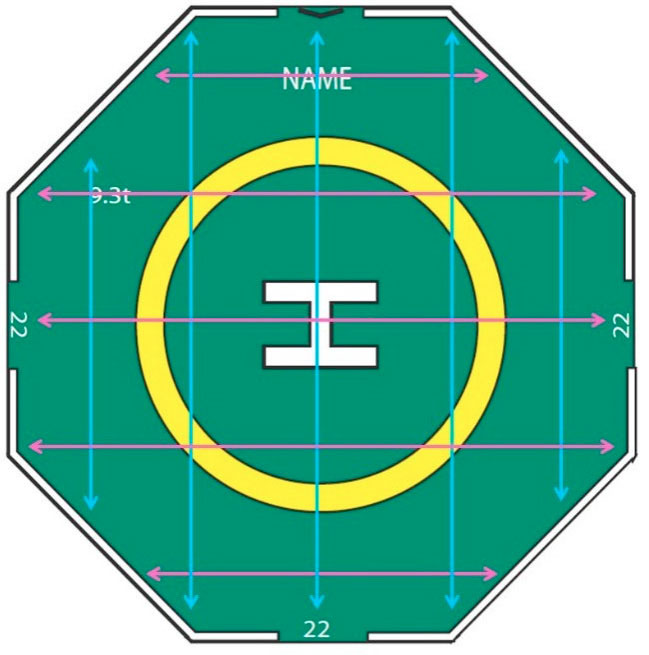
- Entire landing area to be covered by parallel runs at no greater than 1m centers, repeated with orthogonal runs as shown in Figure 1 below.
- For profiled helideck surfaces only, the direction of testing should be parallel to the ribs. No orthogonal runs are required
-
Figure 1: Helideck friction survey procedure using CFME testers
Survey reporting
General
-
- The following information should be included in the survey report:
-
-
- The name of the helideck/installation.
- The name of the surveyor.
-
The date of the survey.
-
-
- The type of helideck, e.g. flat textured, profiled (grit blasted/friction painted/no texturing).
- The condition of the helideck surface at the time of testing, e.g. wet/dry.
- Details (e.g. location, size, nature of damage) of any damaged or suspect areas on the helideck surface.
- The prevailing weather conditions.
- The type, serial number and calibration details of the friction tester.
- The orientation of the test runs.
- Photograph(s) showing the entire deck surface with close-up photographs of any non-compliant or damaged areas.
- Survey results as described below.
-
Presentation of Results
-
- The results should be presented as follows:
-
-
- For entire landing area, a matrix of readings for each 1m square comprising:
- for flat helidecks the average of the 1m square readings for the two orthogonal runs;
- for profiled helidecks the 1m square readings for the runs parallel to the ribs only.
- Average values comprising the average of the 1m square average values for the 1m squares:
- inside TD/PM circle,
- outside TD/PM circle,
- on the paint markings (where TD/PM circle and H lighting not installed).
-